
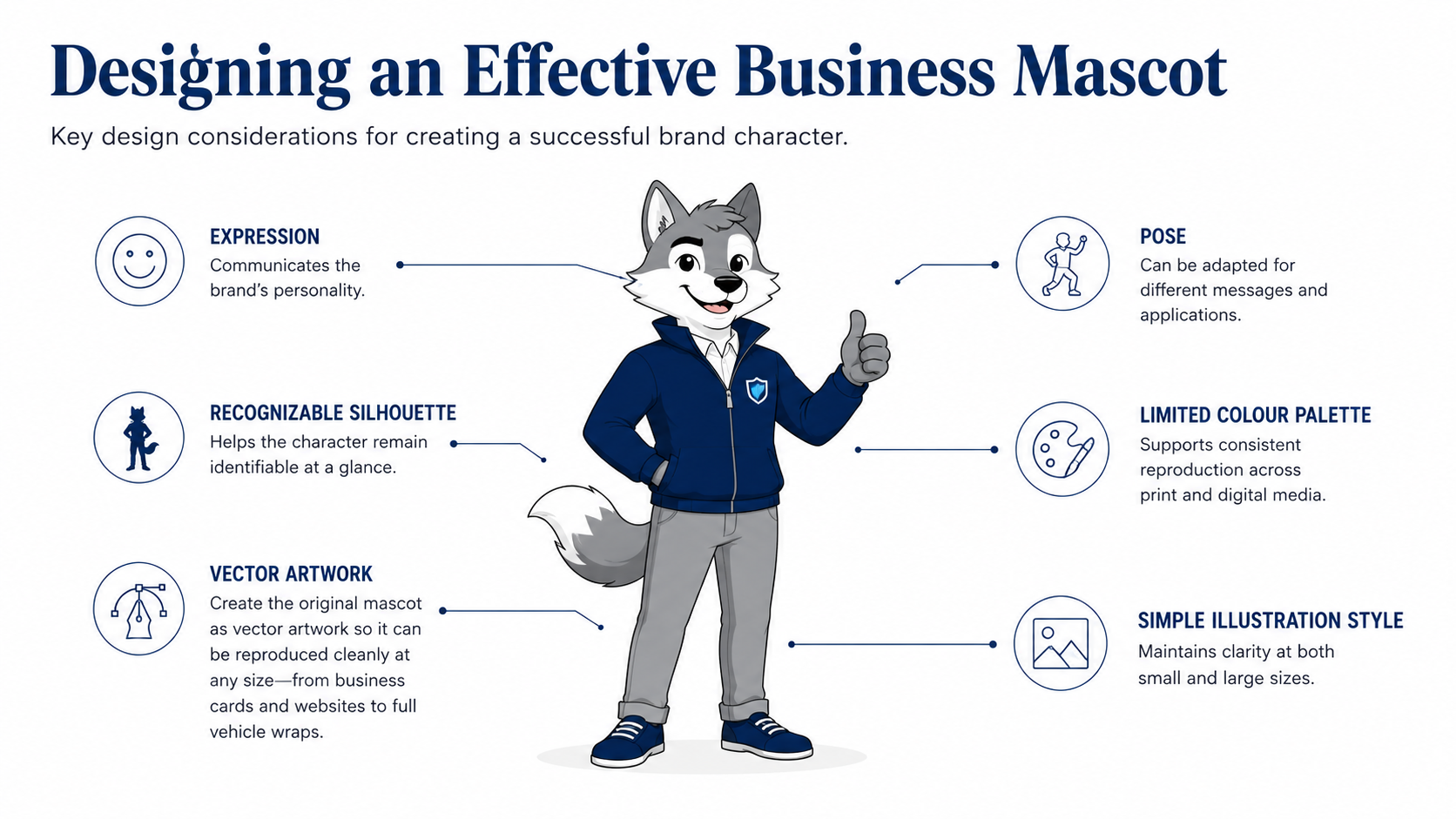
Understanding what mascots contribute to a brand—and when they’re the right choice.
Business mascots have been part of successful branding for generations. Designers often refer to them as brand characters because they do more than identify a business. They can introduce personality, create a relatable face for the company and provide a flexible branding asset that can evolve across many different applications.
That doesn’t mean every business should have one. Like every branding decision, the value of a mascot depends on the business, its audience and the image it wants to project.
Every branding element has a role
Successful brands rarely rely on a single design element. A logo identifies a business. Colour builds recognition. Typography helps establish tone. A tagline reinforces a message or point of difference.
A mascot contributes something different.
It can express personality and become the friendly face of a business, helping communicate qualities such as craftsmanship, reliability, innovation, approachability or humour without relying solely on words.
For businesses where personality is an important part of the customer experience, a mascot can become a valuable extension of the brand.
Designed to be used
Unlike most logos, a mascot is intended to be adaptable.
The same character might welcome visitors on a website, demonstrate a product or service, celebrate an anniversary, support a seasonal promotion or appear in social media posts. It can evolve to suit different situations while remaining recognizably the same character.
That adaptability allows a mascot to become an active participant in the company’s communications rather than simply another graphic element.

Why mascots often work well on vehicles
Unlike a business card or website header, a van or truck offers a generous canvas. That gives designers greater freedom to establish a clear visual hierarchy and use branding elements at a scale that simply isn’t practical on smaller brand assets.
Depending on the design, a mascot may play either a supporting or leading role while the remaining branding elements work together to communicate the company’s identity.
When a mascot may not be the right choice
A mascot isn’t a requirement for successful branding. Many businesses communicate their identity exceptionally well through a distinctive logo, thoughtful typography, strong colour choices or a clean graphic style.
Adding a mascot also comes with responsibilities. It becomes another branding asset to manage. It needs sufficient space to be effective, guidelines for consistent use, and ongoing application across the business if it is to become a recognizable part of the brand.
Good branding is intentional
One principle applies to almost every successful branding project:
Every visual element should have a purpose.
Whether it’s a logo, a mascot, typography, colour, a graphic motif, photography or a tagline, each element should contribute to the overall identity of the business. If it doesn’t, it probably doesn’t belong.
At Prima Graphics, we don’t see mascots as a branding requirement or a design trend. We see them as one of many creative tools available to express a company’s identity.
For some businesses, a mascot becomes an enduring and memorable part of the brand. For others, a confident logo and clean, well-considered graphic design communicate the brand more effectively.
The best branding isn’t about using every available tool. It’s about choosing the ones that communicate your business most clearly and authentically.